Iconology of the Fortitude Cards
From the Iconology Section of the Robert O'Neill Library
The ninth Tarot trump according the type B ordering is the virtue Fortitude and the five surviving cards from the 15th/16th century are shown in Figure 1. Two of the cards show a woman in a long tunic holding or breaking a pillar.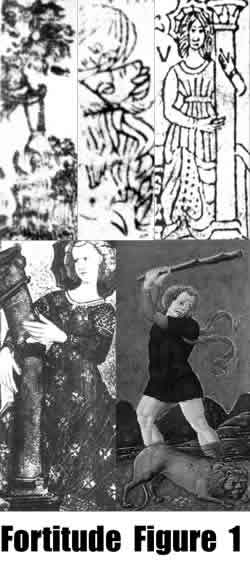 Two cards show awoman or man closing the mouth of a lion. One shows a man about to hit a lion with a club.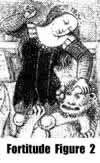
The image of a woman wrestling with a lion is a common representation of Fortitude. Figure 2 shows a typical example from 1355 in Milan. Hind (1935, p. 151) shows a 1464 woodcut of a woman forcing open the jaws of a serpent. The image is similar but is not explicitly identified as a virtue. Another example by Bellini (1470) can be seen at:
www.getty.edu/art/collections/images/m/00033801.jpg
The second image in the early cards is woman holding/breaking a column which is also a traditional symbol for Fortitude. An example from ~1435 can be seen at:
gallery.euroweb.hu/html/u/uccello/2prato/
The figure breaking a column is also the representation used in the so-called Tarocchi de Mantegna:
https://www.britishmuseum.org/collection/object/P_1895-0617-137
Hourihane (2000, pages 205ff) provides a list of the location of 73 images of Fortitude.
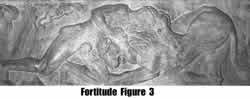
The man wrestling the lion is related to the traditional image of Hercules (Figure 3, ~1473). Hercules had been adopted during the middle ages as a symbol for Fortitude, so this is not a representation unique to Renaissance Humanism (Godwin 2002). Hercules with club and lion skin can be seen as a symbol of Fortitude in a 1260 image from Pisa:
www.kfki.hu/~arthp/html/p/pisano/nicola/1pisa_fo.html
Another example of Hercules can be seen in Seznec (1953, fig. 5).
The religious tradition
 All of the representations of the woman with column or lion belong, of course, to the Religious artistic tradition. The image of Hercules might be thought to be an exception and yet has a long history in Christian art where the Greek hero is replaced by a biblical character. The visual images of Daniel in the lion's den go back to the Roman catacombs (Grabar 1968).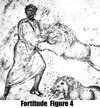
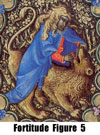
Figure 4 is a 4th century image of Samson (Judges 14:5ff) from the catacombs. Another image of Samson forcing open the lion's mouth can be seen in Saxl (1953, fig. 20) from a 12th century column capital. Figure 5 is a 15th century image of Samson from a psalter that also shows the typical imagery. Another image shows Samson astride a lion and forcing open its mouth.
 Similar images of David opening the lion's mouth and saving the lamb are less common but also can be found, e.g., Figure 6. Bouche (2000) shows a similar image of David from a psalter of 1131-1143. Williams (1994, p. 81) gives another example from a 12th century bible. Weinstein (1997, p. 66) has another from a 12th century Psalter.
The triumphal tradition
Hercules is briefly mentioned in Petrarch's Triumph of Love: "with him is Hercules, for all his strength love still captured him" Hercules occasionally appears in images of the Triumph of Love walking alongside the triumphal chariot and carrying a column.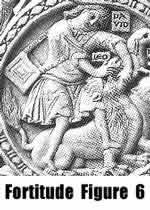
I am not aware of any images resembling the Fortitude card that appear in either the Dance of Death or the Apocryphal artistic traditions.
Iconological analysis
The symbolism associated with the virtue Fortitude was always variable. The most common representations were a woman/Hercules/Samson/David with a lion and a Woman holding or breaking a column. A third representation, which does not appear in the early Tarot cards shows a woman in armor. An example from 1470 can be seen at:
www.artchive.com/artchive/B/botticelli/fortitude.jpg.html
The woman in armor tends to be earlier in time. Katzenellenbogen (1939, figs. 32 and 33) shows examples from a 9th century bible and from ~1130.
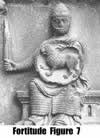 There are also a number of examples in which the various symbols are mixed in a single image. Figure 7 shows a 13th century image of Fortitude in which the woman in armor is carrying a club and has a lion on her shield. The Viscounti psalter of ~1412 (LF129v) has Fortitude as a woman with a lion skin as headress and cape and carrying a shield and staff.
Interpretation
The 15th century card-player would have recognized the various symbols of Fortitude and would have known this virtue as related to the courage and stamina needed to "stay the course" and resist the temptations of life. This would probably have been the first thing that came to mind upon seeing this card.
Perhaps the player would have noted that Fortitude (#9) followed the martial image of the Chariot (#8). Fortitude was the inner strength needed to gain spiritual victory. Perhaps the card-player would have noted a transition from the external human life represented in earlier cards. The idea of a transition might have been reinforced by the Wheel (#10) symbolizing the temporary nature of human victory and leading to a need for a deeper spirituality, represented by the Hermit (#11).