Iconology of the Hanged Man Cards
From the Iconology Section of the Robert O'Neill Library
Introduction
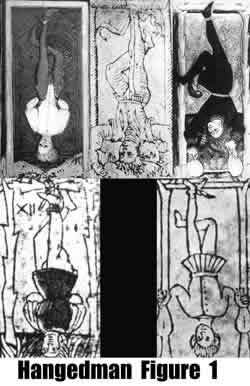
Five of the extant 15th and 16th century Hangedman cards (#12) are shown in Figure 1. There is an additional fragment (Kaplan Volume 2, p. 286) that shows only the lower right hand corner of a card and does not add much.
 There is also a card shown in Kaplan (Volume 2, p. 288) which seems to belong to a later generation. The man is hanging from elaborate columns and his foot is tied by a ribbon.
The early images of the hangedman show a remarkable similarity compared to other trump cards. All of the cards in Figure 1 show a man hanging upside down by one foot. The gibbet is wooden and formed of two uprights and a crosspiece. The uprights are smooth in 3 cases and rough-hewn in two. In two the arms are tied behind, in the others the arms are hanging. In two the man is holding bags of money. The foot is tied by rope in four cases and by a ribbon in the fifth. The man is hanging by the left foot in two images and by the right in three.
Moakley (1966) recognized the hangedman as a "pittura infamante" (picture of infamy or "shame painting"). Criminals who escaped justice were often tried in absentia and depicted on the outside walls of the jail in this embarassing inverted position (Egerton 1985). The images were only expunged if the criminal were captured or if they made reparation. Traitors and conspirators were also treated to the same infamy on city walls or bridges. However, since these public displays were exposed to the elements, not a single example survives.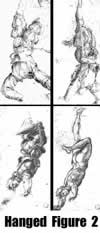
Without surviving examples, Moakley (1966) based her discussion on written descriptions of these pitture infamanti. She apparently was unaware of published versions (Freedberg 1963, Shearman 1965) of the chalk drawings of Andrea del Sarto. These practice sketches, a few of which are shown in Figure 2, were done in ~1530 to prepare for a public "shame painting" (Burke 1972). The commissioning of talented artists to draw these images had a long tradition. Andrea del Castagno (1440) and Botticelli (1478) had both painted such images on the jail in Florence (Burke 1972).
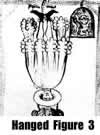 The "shame painting" was not restricted to Italy. Figure 3 shows an image of a disgraced German noble with his heraldry (~1438). Figure 3 is interesting because it shows the uprights and crosspiece characteristic of the early cards.
A comparison of Figures 1 with Figures 2 and 3 is convincing evidence that the "shame paintings" were a source for the hangedman imagery. The sparse evidence does not explain the tied hands or money bags which may hold additional symbolism. But the general configuration of the images is quite similar.
However, the puzzle of the Hangedman is not solved by discovering the similarities to the "shame paintings". It remains to be explained why the inverted image was associated with infamy. Saxl (1957, plate 40), for example, shows an earlier 14th century image of Saturn falling in the inverted position. This astrological image implies a more general symbolism involved in the falling figure than simply a secular image that would embarrass the unpunished.
The religious tradition
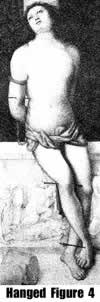 The many implications that might be associated with the hangedman image in the mind of the 15th century card-player only begin to become clear when we examine the religious art tradition. Consider, for example, the commonplace image of the early Christian martyr, St. Sebastian (Figure 4). Here we find the head thrown back, the hands tied behind and one foot crossed behind the other. So the body position is correct, but the figure is not inverted. Here the symbol is a blessed and faithful martyr. By inference, the inverted image would imply the opposite: the unfaithful, the traitor. Thus, we find Dante portraying the traitorous Pope Nicholas III as stuffed upside down in a rock (Inferno Canto 19). We also find a 12th century bas-relief (Figure 5) that shows Simon Magus falling from the sky. Traditional imagery also depicted the prideful Lucifer being cast headlong from heaven.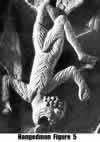
The contrast between Figures 4 and 5 would suggest a simple good-bad dichotomy involved in the inverted figure. The upright figure denotes fidelity and sanctity and the inverted figure implies the reverse, treachery and evil. As we will see in the following section, falling figures were common in the Apocalyptic representations of hell and punishment.
But the religious tradition also provides an important counterexample in the martyrdom of St. Peter. Figure 6 shows a typical example from a 1435 altarpiece at Pisa. Similar images can be found on the 15th century doors to the Basilica of St. Peter's in Rome (Welsh 1997, p. 245) and in an altarpiece of ~1320 by Giotto (Girardi 1999, p. 119). This imagery comes from the apocryphal Acts of Peter (James 1924) which describes Peter as requesting crucifixion in the inverted position because he was not worthy to die in the same position as Jesus. Thus, the 15th century card-player knew a familiar example of the inverted position as a symbol of the humility of Peter contrasted with the pride of Lucifer.
Images related to the hangedman do not appear in the triumphal tradition or in the dance of death tradition. Once again we find that the images are drawn from a variety of sources and no single tradition explains all of the trump symbols.
The apocalyptic tradition
The Apocalyptic tradition provides a treasury of images that resemble the early Tarot card. All of the examples inverted figures being thrown into hell and subjected to punishments at the Last Judgment. Some of the images, such as the ~1500 fresco by Signorelli at the Orvieto cathedral (Figure 7) are true masterpieces. Very similar inverted positions are assumed by sinners being thrown into hell in a 13th century illustrated Apocalypse (Bynum 1995, plate 28). Giotto's fresco in the Arena Chapel in Padua shows a cleric with hands behind his back and both knees bent (Edgerton 1985, p. 28; Morgan and Morgan 1996, p. 104). The unfortunate sinner is hung from a rough-hewn branch and suspended by a rope tied to his genitals.
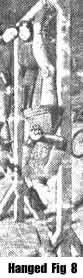
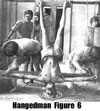 Figure 8 is a small detail from a 15th century manuscript showing a noble being punished in hell. He is hung by the heels from a gibbet that resembles the early cards and his hands are tied behind his back. Similar punishment on an upright and crossbeam cross can be seen in a late 14th century fresco in a parish church in Viboldone (Russell 1984, p. 262). The sinner is hung by the knees and has his hands tied behind his back. Sinner hung up by their knees can also be found in a 16th century oil painting (Grubb 1997, p 119).
Figure 9 is particularly interesting because it shows sinner in the mouth of hell in both the upright and inverted positions. The image is from a 1475 illustrated manuscript of the vision of Tundal (see separate article on the Fool's Journey). The image is interesting because it further complicates any interpretation of the inverted figure. Here both the upright and inverted figures are identified as sinners.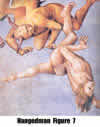
 Perhaps the most important, and most convincing, image from the Apocalyptic Tradition occurs as a small detail in a ~1410 fresco (Figure 10). The fresco is by Giovanni da Modena and is in the cathedral of San Petronio in Bologna. The image is so strikingly similar to the early Tarot cards that it may have served as an actual model. Its early date of ~1410 means that Figure 10 is unlikely to have been derived from a Tarot image. On the other hand, the date and the image's public accessability in a cathedral means that it would have been available as a model. Of course, it remains possible that both the Hangedman and the Bologna fresco are derived from earlier shame paintings that were also publicly available.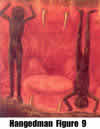
Iconological analysis
The early Hangedman images appear to be related to secular "shame paintings" and to apocalyptic images of infernal punishment. But there is no reason to think of these as competitive explanations. In both cases, the image is associated with punishment. The images in Figures 2 and 7 resemble each other and do not appear to express two antithetical themes. In essence, the shame painting can be seen to imply a familiar depiction of punishment in the afterlife since the criminal had escaped punishment in this life. So, although I have no collaborative evidence to offer, the secular imagery can be reasonably hypothesized as derived from the apocalyptic imagery of Hell. Even if the hangedman was only associated with a shame painting in the mind of a hypothetical designer, still the resemblances to the apocalyptic imagery would probably have occurred to the 15th century viewer.
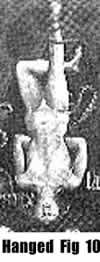 With the Hangedman, we begin the sequence of cards that appear to be closely related to the apocalyptic imagery familiar to the 15th century viewer. So here, and in subsequent chapters, we will be concerned with finding examples of the close associations between images that became sequential images in the Tarot. So it is important to realize that Figures 7, 8, 10 and the examples cited in the text are details extracted from illustrations of the Last Times. Thus, these details occur in the same visualcontext as the remaining cards in the Tarot.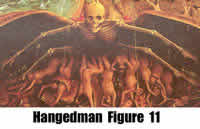
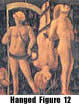
The association of these images can be illustrated by examples in which images resembling the Hangedman appear in close association with images of Death which is the next card in the Tarot sequence. Figure 11 is a portion of a painting ~1440 that shows the inverted figures dangling under the figure of Death. Figure 12 is a small detail from Fra Angelico's painting of the Last Judgment (~1431-5). It shows a hangedman between an upright figure and a figure holding the scythe of Death. There is also a bas-relief at Notre Dame that shows Death as a blindfolded (i.e., non-discriminatory) woman on horseback. Death is dragging off a man who appears in an inverted position like the Hangedman (Panofsky 1939, figure 81).
 But seeing the Hangedman image as representing punishment (secular or religious) does not consider the full complexity of the symbolism. The contrast between upright and inverted figures was not simply associated with punishment since both upright and inverted figures appear in Figures 9 and 12. In many accounts, sinners in hell will be turned upside down (Gorevich 1988). But in Late Medieval imagery and drama, the viewer knew that a significant transition had occurred when everything reversed - it was a kind of dramatic device to alert the viewer that they were now seeing action in the afterlife (Palmer 1992).
The most important account of this inversion occurs at the end of Dante's Inferno. Dante and his guide Virgil have descended into the depths of hell in an upright position. But at the bottom of hell, Dante is turned upside down and begins the ascension through Purgatory to Paradisio. To Dante, the inversion experience was a turning of values upside down - a conversion experience required for further progress. Thus, the later occultists interpretation of the Hangedman as a reversal of values and a pivotal experience was quite familiar to the 15th and 16th century card-player through Dante's account.
This image of being inverted as a necessary step in a spiritual path may seem foreign to a modern reader. But it would not have been foreign to the 15th century viewer of the early Tarot. They would have been familiar with the idea of the Fool turned upside down (Davidson 1996). Bernard of Clairvaux described the experience of the spiritual aspirant who had experienced the reversal of values (James 1953): "We are like jesters and tumblers, who, with heads down and feet up, exhibit extraordinary behavior ..."
Interpretation
It remains to reconstruct what the 15th century card-players might have seen in the Hangedman symbol. It seems reasonable to assert that they would have recognized the image as a "shame painting" or an image from hell. In either case, the image would have communicated treachery and punishment: Lucifer and sinners being cast headlong into hell.
But while the first impression might have been negative, there are also hints of the humility of St. Peter. Thus, while the inverted position might be considered as punishment when forcefully imposed, when voluntarily adopted it might have been associated with the spiritual conversion experience of Dante or Bernard's "Fool for Christ" turning cartwheels. So the material was also available to the card-players who might have seen the symbol as representing a reversal of values, a voluntary reversal that permits the mystical experience represented in the remaining trumps.