Iconology of the Hermit Cards
From the Iconology Section of the Robert O'Neill Library
Introduction
Card number 11, the Hermit, has five survivors from the 15th/16th century (Figure 1). All of the images show an old bearded man.
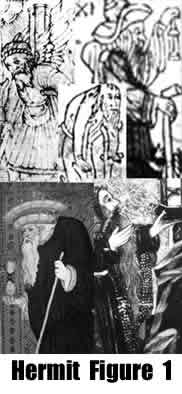 Four of the figures support themselves on crutches, cane, or walking stick. One carries a cylindrical lantern and two have hour glasses. Two appear in traveling cape and wear large hats. One wears armor. One has wings and a pillar in the background.
Religious tradition
Two of the early cards show a figure in traveling robes and look like contemporary representations of pilgrims and hermits (Figure 2, 15th century). Another example of a pilgrim that resembles the early Hermit cards can be seen in Walker (1984, Fig. 26).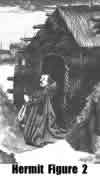
In a 1423 woodcut (Figure 3) we see a kneeling hermit holding up a cylindrical lantern. The phenomenon of the solitary hermit or wandering holy man was common in the medieval period. So the image on the early Tarot cards may simply represent an individual who had rejected the world and adopted a solitary religious life.
Triumphal tradition
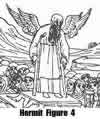
In Petrarch's epic poem, the Triumph of Time presents an abstract concept rather than a concrete image on a triumphal chariot. However, the traditional representation of the Triumph of Time shows an old, winged man on crutches, i.e., Father Time. The examples in Figures 4 and 5 bears a distinct resemblance to one of the early Hermit images. This was the most common representation of the Triumph of Time and 15th century examples can be found in Gombrich (1972, plate 143), Williams (1994, p. 72), and Nyhoom (1990, figs. 11, 12).
The images of Father Time used in the Triumphal tradition come from an older stratum of symbols. In these older images, Father Time is the god Chronos with wings, a scythe and sometimes hooved:
www.churchmousewebsite.co.uk/coadestn8.jpg
gallery.euroweb.hu/art/g/gunther/chronos.jpg
Dance of death tradition
 The hermit was considered as a separate estate of man in the Dance of Death tradition. However, there are representations of old men and friars that resemble the early Tarot cards. For example,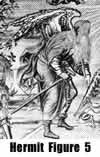
www.godecookery.com/macabre/holdod/holdod33.htm
Apocalyptic traditions
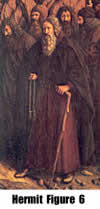 The figure of the Hermit or pilgrim doesn't play a central role in the Book of Revelations. However, images similar to the early Tarot cards do appear in contemporary imagery. Figure 6 from ~1432 shows a group of holy men approaching the final judgment in anticipation of their final reward in heaven.
Iconological analysis
The concept of the Hermit may seem simple to us today, but the variable images in the early Tarot cards reveals of a more complex constellation of associations. One of the cards clearly represents the Greek god of time, Chronos. But as pointed out by Panofsky (1939) the Latin name for Saturn is Kronos and the confusion of names led to a mixture of symbols. Saturn is the patron of agriculture and therefore Father Time sometimes carries a scythe (Figure 7). The Hermit and monk are shown in depictions of the "children of Saturn" (Figure 7). Time was also thought of as the "revealer", as in the expression "time will tell", and this probably accounts for the transformation of the hourglass into a lantern.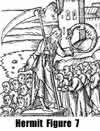
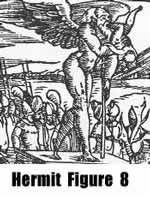 Though it doesn't appear in the early Tarot cards, the typical representation of Saturn eating a human, also gets transferred over into images of Time (Figure 8). Other images show Saturn mixed with imagery of Father Time.
www.billyandcharlie.com/planets/saturn.html
And as if the symbolism were not already confusing enough, there is yet another possible association with the Hermit card. Figure 9 is a photograph of an Italian confraternity brother. The robes and lantern resemble the early images of the Hermit. This image is particularly intriquing because of the speculation that a confraternity was the patron that commissioned the original Tarot deck. It was common for the patron of a work to have their own image incorporated into the product. Thus, a confraternity brother appears in a Dance of Death that was probably commissioned by a Confraternity.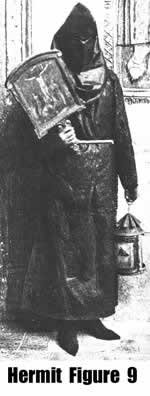
Interpretation
The mixed symbolism on the early Tarot cards suggest a range of interpretations that might have occurred to the 15th century card-player. The first association would probably have been Father Time, older and wiser after the experience of cruel fortune in the previous card (#10 Wheel of Fortune). Perhaps they would have seen the image as the old man usually displayed as crushed under the Wheel. Perhaps the image of time and the old man would have been associated with the Death card (#13) that follows later in the deck.
A second association may well have been made with the Hermit or pilgrim as a person turning to a more spiritual life in old age. The Hermit might have been seen as a logical consequence of the dissatisfaction with the victories of youth (#8 Chariot). The Hermit, pilgrim, or wandering holy man was a familiar figure to the card-player and probably much admired. The card-player would have heard sermons by the mendicant preachers lauding the path of apostolic poverty. Perhaps the Hermit card would even have suggested a friar.
The identification of the Hermit as a holy man is interesting because it would have mixed connotations at the time. If the Hermit were seen as friar, pilgrim, or as a symbol of the need to prepare for an approaching death, then the Hermit card is a total orthodox Christian concept. But if the symbol were seen as hermit or itinerant holy man, then it's orthodoxy is questionable. Such individuals appeared frequently in the late middle ages and posed a problem for the Church. They were often well-intentioned spontaneous mystics that preached the need to repent in anticipation of the coming apocalypse. But they were not well educated in theology and often preached errors to the annoyance of the Church. At other times, the itinerant preacher was not so well-intentioned and delivered a more radical anti-cleric and anti-papal message that was common at the time. So the Hermit might also represent a more esoteric symbol, one that was far from orthodox.
The educated card-player would have seen the association with Saturn and the Hermit would have suggested an astrological interpretation. Given the attitudes toward astrology common at the time, the interpretation might have been an orthodox association with the Hermit as a "child of Saturn". But the association might also have been to esoteric concepts of divination and astrological image magic.
The identification of the Hermit image with a confraternity brother must be considered as speculative. However, the idea is not as fantastic as it might sound on first reading. In the city states of Italy in the 15th century, many of the men were members of such a confraternity. Thus, there is a fair likelihood that the card-player would have been a member and predisposed to recognize the association with the confraternities.