Pope Cards
The Iconology from 15/16th Century
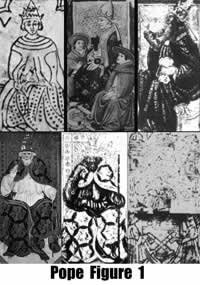
Figure 1 shows the 6 extant Pope cards from the 15th and 16th centuries. As with the Emperor, all of the figures are enthroned. The keys of St. Peter are shown on three of the cards, claiming custodianship over the temporal and spiritual world. All of the figures wear heavy robes appropriate to the status of the Pope. The Pope is crowned though he does not always have the traditional triple tiara. On three of the cards, the pope has the right hand raised in the traditional 3 fingered papal blessing. Only 2 of the early cards show the pair of cardinals or acolytes that became an important feature of later decks.
 There is certainly no lack of papal images in late medieval Italian culture and the card-player would have immediately recognized the figure. Some, like the 14th century image in Figure 2, bear a distinct resemblance to the early Tarot cards. Figure 3 is from the late 15th century Borgia apartments of the Vatican and shows the Pope and Emperor seated together. The pope is also represented in the so-called Tarocchi of Mantegna, representing the highest estate of man. The card-player was also likely to have been familiar with the public images on the papal tombs (e.g., see Ragg 1973, pages 2, 23, and 48).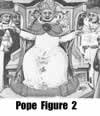
The pope also occasionally appears as a symbol of the planet Jupiter (Figure 4). Rare examples of the pope as Aries also can be found but the identification with Jupiter is more common.
Religious tradition
It hardly needs to be argued that images of the Pope appear commonly in the contemporary art of the religious tradition. But for the sake of making the imagery more widely accessible, it is worth providing a few examples. Figure 5 is a woodcut from Ferrara ~1478. Here the pope appears with 2 cardinal and hand raised in blessing. Notice that it is the left hand that is raised, a common error in woodcuts where the original carving in the wood appears in reverse on the printed image. A similar woodcut from ~1476 can be found in Hind (1945, p. 261).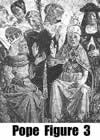
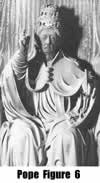
Figure 6 is an image of Pope Martin (1419-1421) from the Milan cathedral and shows the typical image with triple crown and papal blessing. Figure 7 (~1470) again shows the 3-fingered blessing and the full-face posture shown on 4 of the 6 surviving Pope cards (Figure 1).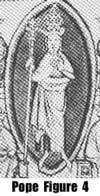
Triumphal tradition
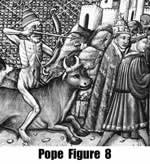
The figure of the Pope doesn't appear in Petrarch poem. However, like the Emperor, the Pope appears in the artistic tradition associated with the Triumph of Death. In Figure 8, Death in papal tiara appears riding a bullock. Although there is no triumphal chariot, the bullock is traditionally associated with representations of the Triumph of Death. In this illustration from a 15th century Psalter, Death is shown with bow and arrow aimed at ruler and Pope.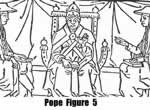
Figure 8 is clearly a mixture of the Triumphal and Dance of Death traditions. The Pope appears as Death itself, triumphant dispenser of ultimate justice. The Pope also appears as victim of death though he represents the highest estate of man. Figure 8 is also interesting because, once again, it shows two of the Tarot symbols, Emperor and Pope, in the same image.
 In other examples of the triumphal tradition, we find the Pope fallen under triumphant Death, e.g., www.geocities.com/ppollefeys/triomphe_inconnu.jpg.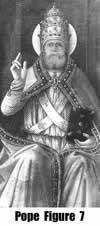
Dance of death
As the highest estate of man, the Pope also appears in artistic representations of the Dance of Death. In a 1485 woodcut (see chapter on Iconology of the early Death cards, Figure 5) the Pope is being led off by death. And here again the Pope and Emperor appear in the same image.
In a 1485 fresco (see chapter on Iconology of the early Death cards, Figure 6) we see Death triumphant with the Pope and Emperor at his feet.
Apocalyptic tradition
In many apocryphal image of the Last Judgment, we see images of Popes being led off to punishment or reward at the end of time. The representations are similar to those of the triumphal and dance of death traditions.
Perhaps more interesting are the apocryphal scenes in which God is represented as the Pope, as the ultimate and final spiritual power. Figure 9 (~1432) shows God as Pope as a dominant figure in a representation of the Last Judgment. In a 15th century psalter, (Meiss 1972, Fig. LF11v) God is represented with a long white beard, 3-fingered blessing and pair of keys. In this image, Justice is shown at the right side of God.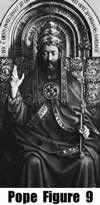
Iconological analysis
The first association of the Pope image is, plain and simply, the individual who has been elected to this position. This is clear from the extensive use of the traditional imagery on portraits, tombs, and public statues. As the first association of the Emperor image would have been the Holy Roman Emperor, so the first association of the Pope image would have been the bishop of Rome.
It is interesting, therefore, that two of the crowns shown on the early cards (Figure 1) are not very accurate representations of the familiar triple tiara. It is possible that the artist or woodcarver was simply cutting corners by drawing a simpler version of the crown. But it is also possible that that the simplification is deliberate. The triple tiara represented the papal claim to jurisdiction over (1) the Papal States, (2) the temporal world and (3) the spiritual world. In the northern Italian city-states of the early 15th century, when the Tarot was first designed, the extent of the pope's temporal jurisdiction was very much a matter of controversy. So the image with a single crown (Figure 1) may hint that the artist only acknowledged the pope's spiritual rule. The image with a double crown might acknowledge the pope's spiritual rule and temporal jurisdiction over the Papal States, but not over the other city-states.
Beyond the obvious representation of the bishop of Rome, the Pope image also was a familiar representation of the highest estate of man. This is probably the reason that he so frequently appears alongside the Emperor, representing the highest temporal estate. The two highest estates appeared together so frequently that the 15th century card-player would not be surprised to see the two images juxtaposed and would not have seen the Tarot majors as independent and unrelated symbols. Indeed, the card-player may have been exposed to a mixture of symbols that seems to blend the Emperor and Pope into a single image.
Figure 10 shows an enthroned figure with elaborate robes giving the papal blessing. But the figure wears the domed emperor's crown and is holding an orb in his lap. So the figure could also be the Holy Roman Emperor. The mixture of symbols is probably explained by the halo. This is a representation of God the Father as ultimate ruler of both temporal and spiritual realms. A similar image with papal blessing and orb is seen in Figure 11 and seems clearly to blend the symbols of temporal and spiritual rule into a representation of God.
But if the Pope were seen as the spiritual representation of God on earth, the apocalyptic vision of the 15th century would also have seen him as the prophesized Antichrist who would appear in the last days. Although far less common than the traditional spiritual role, images from late 15th century can be found that equate the Pope and Devil.
Two examples are found at:
www.godecookery.com/macabre/gallery3/macbr90.jpg and
www.godecookery.com/macabre/gallery1/macbr20.htm.
Interpretation
Much as we see among Roman Catholics today, the 15th century card-player would have viewed the Pope with a deep reverential awe. As the supreme pontiff, the Pope was Christ's representative on earth and the pinnacle of the sacred institution of Christianity.
The Pope was the highest achievable estate of man, once again eliciting a respectful awe. For some, the Pope held a particularly respected position since he was elected by his peers, rather than acquiring the position by accident of birth. However, contemporary with the invention of the Tarot the Popes were largely aristocrats.
As the head of the Church, the Pope held unquestionable power over the spiritual realm. He alone held the authority to excommunicate and cut off the transmission of grace to an individual. He was unquestionably the hierophant, opening (and closing) the path to eternal life. Once again, this would have elicited a respectful awe from the card-player.
But the picture would not necessarily have been so crystal clear to the card-player. The Pope was also the absolute ruler of the city of Rome and the surrounding area, known as the Papal States. As a temporal ruler he would have been seen as a potential threat to the card-player in another city-state. There was constant conflict and intrigue among these competitive political entities and the Pope wasn't always to be seen as the "good guy", perhaps even bringing out a sense of competition or even fear. The Pope could be a dangerous foe.
It was also abundantly clear that election to the papacy didn't carry with it canonization - few Popes were saints. As a human, the Pope was still fallible and still subject to death and judgment. For many, such as Dante, the office was sacred but the occupant often was not. So for many card-players, the despotism and wealth of the individual pope along with the tyranny of institutions such as the Inquisition would have tempered the reverential awe with strong negative feelings.
We must also keep in mind the prevalence of the apocalyptic spirit in 15th century Italy. The flagellant confraternities and the Spiritual Franciscan preachers saturated the cultures with the expectation of the final times. Joachim of Fiore's prophesy to the coming of the Antichrist followed by the saintly pope must have left many wondering exactly where they were in the sequence.
So the image of the Pope must have been associated with a complex constellation of reactions in the card-player. There was reverence and respectful awe on one hand. There was suspicion, jealousy and often hatred on the other. The distinction between office and occupant might have been clear to theologians but must have been confused in the emotions of the card-player.