Iconology of the Star Cards
From the Iconology Section of the Robert O'Neill Library
Introduction
In the previous chapter we examined the Star, Moon, and Sun cards as representing the general concept of the Heavens. And, indeed, the majority of the related imagery from the 15/16th centuries shows these celestial bodies in various combinations.
 However, the Star has other connotations in the iconology of the late Medieval period.
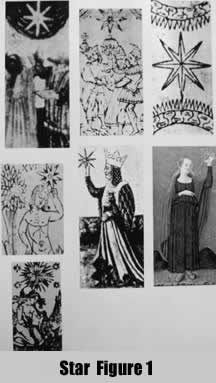
Figure 1 shows the seven extant images of the Star from the early Tarot decks. The most conspicuous feature is the star itself, eight-pointed in six images and six pointed in one of them. In one case, the star occurs alone, framed above and below by stylized clouds. In three cases, the star is being held by a figure. The other three images are more difficult to characterize. One shows a pair of astrologers looking up at the star. One shows a group of three, including a king and two magi. They are holding up a crown and an orb appears to be floating. One shows a kneeling woman, hair blowing and naked except for a headband. She is emptying two large water jars, one on her shoulder and one in the crook of her arm. There is an additional card (Kaplan Volume 2, p. 288) which may come from the 16th century. This shows an 8-pointed star and a clothed and naked man who appear to be wrestling.
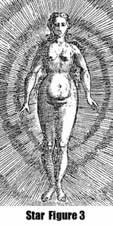
Some of early images may simply be cosmological references as implied in the images showing the star alone or with two astrologers (Fig. 1). Figure 2 shows an image of the eighth sphere, i.e., the sphere of fixed stars, from the 15th century prints known as the Tarocchi del Mantegna. Like some of the early Tarots, this shows a female figure holding up the stars. The Tarot images may also be related to the images of Venus shown as a naked woman in the center of an 8-pointed star (Seznec 1953, p. 200). Related images (Fig. 3) show the spirit of the world, or the spirit of Mercury, in the center of a radiance (15/16th century).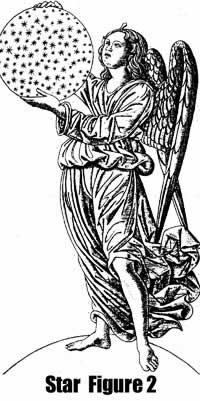
 I am unable to verify the possible identification with the constellation Aquarius, because the 15th century images I have located depict Aquarius as a man emptying a single large jar. The Tarot images showing the woman with two jars may also relate to early 15th century allegorical images of Grammar, one of the liberal arts. Grammar sometimes appears (Fig. 4) as a naked woman with 2 jars and pouring from one of them.
The triumph tradition
At first sight, the images on the early Star cards seem to have little to do with the artistic tradition associated with Petrarch's "I Trionfi". The artists represented the Triumph of Fame as a chariot pulled by elephants with a woman on top. The woman usually shows a sword in one hand, and the captive Cupid in the other. Examples can be found in Welch (1997, p. 288) and Hind (1935, fig. 285). In other cases, the woman is carrying a trumpet (e.g., Carnelli 1971, plate 14).
But if we look at Petrarch's own description of Fame, we find an image of a woman that shone like a star:
Her that man's life forever saves...This glorious fair Lady much like was she, Unto that bright star that...In the orient or the clear day appears...So great in glory did this Lady excel, That all the elements about her did shine...
So it is possible that the early Tarot images showing a woman and star were influenced by Petrarch. But I know of no representations of the Triumph of Fame that show the Lady holding a star.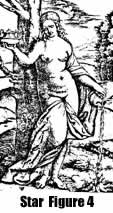
The religious tradition
As a preliminary note, we can mention that the coronated Virgin Mary was venerated as "Stella Maris", the Star of the Sea. One of the early cards (fig. 1) shows a crowned woman holding the star. It is possible that this image might have elicited such an association for the 15th century card-player.
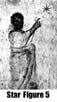 Another possibility is offered by images of the Gentile prophet Balaam from the 4th century Roman catacombs (Stevenson 1978). Balaam (Fig. 5) refused to curse the Jews as demanded by the Moabites and instead prophesized that a future king would arise from the Jewish people: Numbers 24:17 "...a star from Jacob takes the leadership..." The early Christians saw Balaam's prophesy as testament to the mission of Jesus. However, once again, I am not familiar with any medieval imagery which shows Balaam pointing to the star.
A more direct relationship between the early images and religious art can be found in Matthew 2:1-12 - "...some wise men came to Jerusalem from the east. "Where is the infant king of the Jews?" they asked. "We saw his star as it rose..."...Having listened to what the king had to say, they set out. And there in front of them was the star they had seen rising...The sight of the star filled them with delight..."
It seems reasonable to assume that the early card (Fig. 1) showing three figures is a representation of the three Magi. They are dressing in crown and robes that might represent eastern Magi. Also, the figures are offering symbols of rule, i.e., crown and orb, to the infant king. Images showing the star and the Magi go back to the 5th century (Grabar 1968, fig. 134).
Another potential reference may be to Isaiah 47. In this chapter, often called The Lament for Babylon, Isaiah describes the condition of Babylon after it has fallen. If the preceding card (#15Tower) represents the fall of Babylon, then the following may be related to the Star image: "...Sit in the dust, virgin, daughter of Babylon. Sit on the ground dethroned...Wade through rivers, Let your nakedness be seen, and your shame be exposed...Let them come forward now and save you, these who analyze the heavens and study the stars..." Perhaps this is the original intent of the image showing the naked kneeling woman.
Apocalyptic tradition
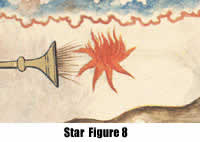
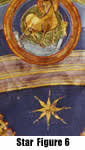 As mentioned in the preceding chapter, the Heavenly Bodies are mentioned in many places in Revelations. In Revelations 4:6, the sacrificial lamb, a symbol of the crucified Jesus, is introduced with a reference to Revelations 2: 28: "...And I will give him the Morning Star." Later (Rev. 22:16), Jesus refers to himself as "...the bright star of the morning..." These references appears in apocryphal art from as early as the ninth century (Fig. 6) as a combined image of the lamb and eight-pointed star. A second mention of the star in isolation occurs in Revelations 8:10: "The third angel blew his trumpet and a huge star fell from the sky..." and Revelations 9:1 "Then the fifth angel blew his trumpet and I saw a star that had fallen from heaven..." The image of the falling star is common in apocalyptic art. Figure 7 is an example from a 15th century Durer print. Other example occur, for example, in a 14th century Apocalypse (Fig. 8) and in another Durer print of 1498 (van der Meer 1978, fig. 192).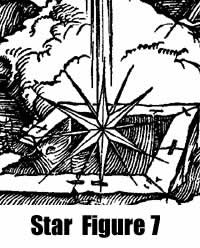
Iconological analysis
A striking feature of the early Star cards in Figure 1 is their variation. The primary impression that the card-player might have seen in this card was simply the Heavens. Perhaps it was the simplicity of the basic concept "Star" that encouraged the artists and craftsmen to suggest other associations - resulting in the many variants.
 Some of the variants are easily explained, e.g., the Star of Bethlehem and the science of Astrology. The figure holding the star may suggest Balaam (Fig. 5), Mary, Venus, the sphere of Stars (Fig. 2), or an allegorical figure such as the Anima Mundi (Fig. 3) or Grammar (Fig. 4). But the simplest explanation may simply be the addition of a human figure - after all, this is how the artist uses figures in the court cards - simply to hold up a symbol.
The variant showing the kneeling woman is more difficult to explain. It may represent Aquarius. It may represent Babylon, destroyed in the previous card (#16 Tower), reduced to a naked slave. But I am unable to locate any contemporary imagery to suggest an explanation for this representation. So one of the seven 15/16th century cards must remain a mystery for now.
One of the interesting features of the early cards in fig. 1 is that additional traditions are synthesized into the imagery. This is a common feature of late Medieval and early Renaissance art which often combined traditions, e.g., classical and religious themes. We find this synthesis of different artistic traditions in many of the Tarot cards. The blending argues against trying to find any single tradition that will explain all of the symbols.
Interpretation
It seems reasonable to assume that 15th century card-players would have viewed the Star card as the first of the series representing "The Heavens". They would also have recognized the reference to Astrology and the Star of Bethlehem, possibly they had also heard about the prophesy of Balaam in sermons.
Because the apocalyptic theme was the theme of many, possibly most, of the sermons they heard, they might also have recognized the Star in this context. The Star might have reminded them of the angel blowing the trumpet and the great star falling. The Star might also have elicited the image of the Morning Star as a symbol of Jesus.